|
||||
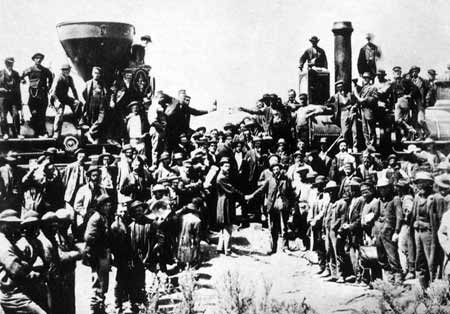
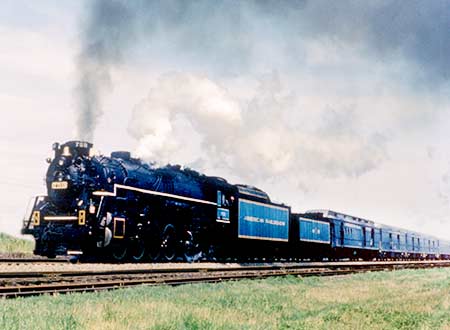
The 1969 Golden Spike Centennial Limited "The last rail is laid, the last spike driven, the Pacific railroad is completed." With those words, the gap between east and west was closed forever. A ribbon of rail now stretched from Atlantic to Pacific, and nothing would ever be the same. In
May 1969, the High Iron Company's 14-car Golden Spike Centennial
Limited took passengers on a two week adventure from the heart of
Manhattan to the rolling hills of Utah in celebration of the 100th
anniversary of the driving of the Golden Spike at Promontory Summit. |
 |
|||
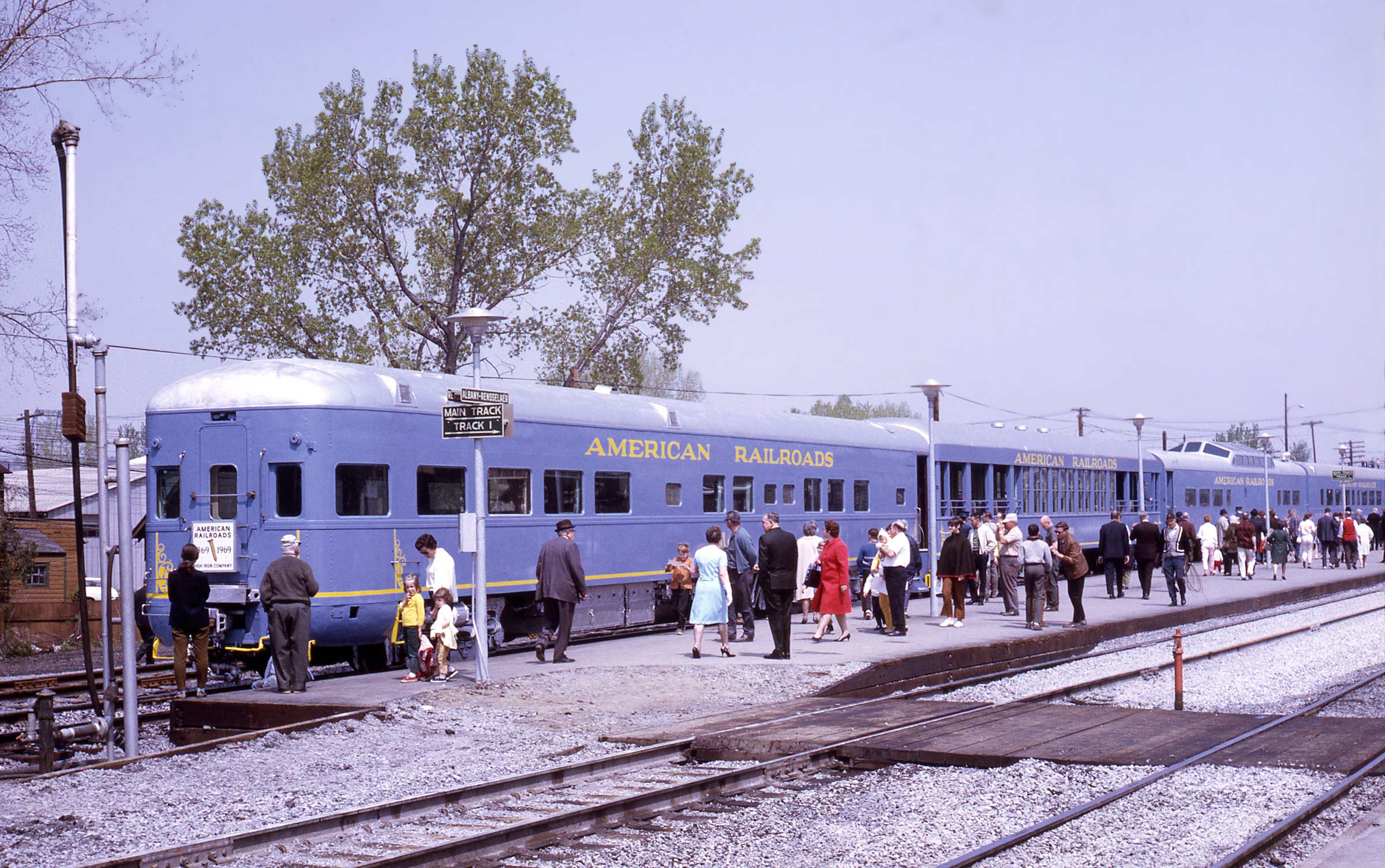
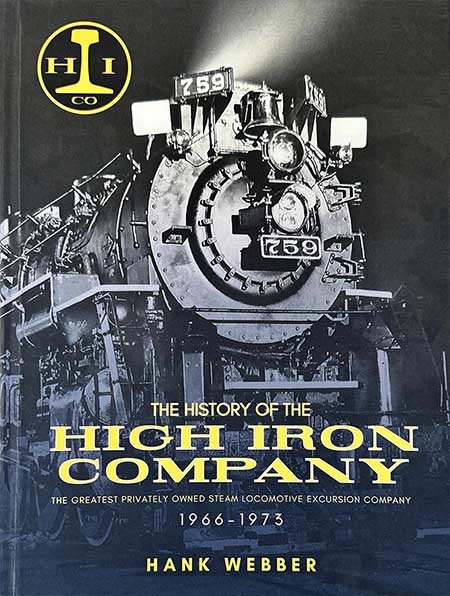
In the spring of 1968, Ross Rowland, Jr., a successful Wall Street commodities broker and railfan, approached the Association of American Railroads (AAR) to see what the railroad industry had planned for next year's hundredth anniversary of the linking of the continent by rail. The answer was 'not much'. The National Park Service, on the other hand, planned a grand ceremony on May 10th at the newly created Golden Spike National Historic Site. But outside of Utah, there were no real plans for drawing attention to this monumental event. Rowland and his High Iron Company crew were already on course to spend thousands of man-hours restoring a main-line steam locomotive -- NKP 759 -- to operating condition. What better way to celebrate the centennial of the Golden Spike than with a cross-country excursion train pulled by 759? Ross and crew got busy and submitted a plan to the AAR to organize and build a special steam-powered display/excursion train to operate round-trip from New York City to Salt Lake City. It would be called the Golden Spike Centennial Limited. The train would consist of three display cars to be open for public viewing at thirteen different stops. Inside these three converted baggage cars would be displays highlighting the past, present, and future of railroading in America. Behind the display cars would be several coach passenger cars for carrying all of the fare-paying passengers -- including two diners to keep them all fed and happy. The AAR gave its endorsement to the plan and things shifted into high gear. By the spring of 1969, the train was ready to go. The train itself was quite a sight. The entire train had been decorated in a special AAR paint scheme -- light blue with gold trim and accents. Across the side of the tender was proclaimed "AMERICAN RAILROADS". The special paint scheme was also given to the Penn Central GG-1 electric locomotive that would pull the train on its final leg back into NYC.
One hundred passengers paid $995 for a round-trip ticket on "The Blue Train", as it came to be called. Dozens of other passengers paid lesser amounts for shorter segments.
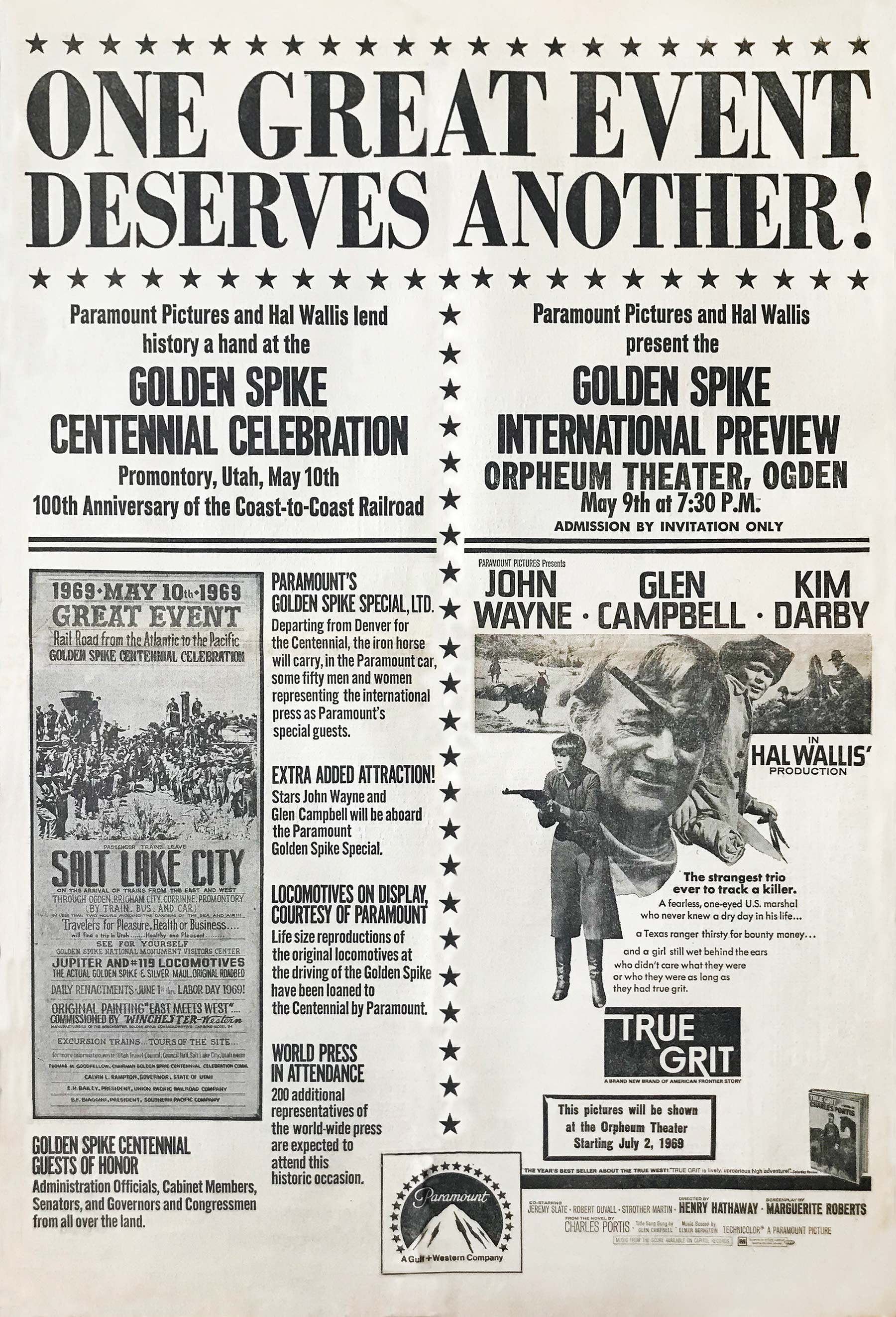
Actor John Wayne rode the train the last day of the westbound excursion into Salt Lake City in a section of the trip that Paramount Studios called 'Paramount's Golden Spike Special Ltd' as part of their promotion of their new John Wayne film. Not coincidentally, Paramount also supplied the two 4-4-0 steam locomotives that were on display at Promontory for the Golden Spike centennial reenactment. Wayne's film True Grit had its world premiere at the Orpheum Theater in Salt Lake City on Friday May 9. (He won an Oscar for his performance.) In a conversation with his long-time friend (and former employee/driver) Ross Rowland, The Duke wondered aloud if there couldn't be a special train for the nation's upcoming Bicentennial... In the end, the 1969 Golden Spike Centennial Ltd would be pulled by ten locomotives -- two steam, two electric (counting the one pulling the train the first 32 miles out of Manhattan) and six diesels -- including the first starring role for Union Pacific's new Centennial (as in Golden Spike centennial) diesel, the largest ever built.
The response to the train at its 13 display stops was overwhelming. In three of the cities, the train crew kept the train open all night for visitors. Using portable stairs and ramps, it wasn't just the three display cars that were open each night -- it was the entire train! Except for the crew car, the public could view everything from the locomotive cab to the observation car at the tail.
The train was an unqualified hit with the public. Thousands toured the train's display cars and many thousands more came to watch the steam locomotive pull the embodiment of America's railroads across the country.
As bold as the GSCL had been, it was nothing like what was to follow for Ross and crew...
The enthusiasm with which the Golden Spike Centennial Ltd was received led directly to America's greatest Bicentennial celebration just six years later -- when over 7,000,000 turned out to visit the steam-powered 25-car red, white, and blue American Freedom Train. |
||||
| 1969 Golden Spike Centennial Special, 1969 Golden Spike Special | ||||